Back to What is Business Analysis Section 2.2

The BA Role Today

The business analyst role in two thousand and twenty-five differs fundamentally from its pre-pandemic predecessor. Where traditional business analysts focused primarily on requirements documentation within waterfall projects, modern practitioners combine strategic consulting, technical implementation, data analysis, and change leadership. This evolution reflects organisational recognition that forty-two per cent better digital transformation outcomes correlate directly with effective business analysis involvement.

Today's business analysts work hybrid or fully remote, facilitating virtual workshops across global time zones using digital collaboration platforms. They leverage artificial intelligence for requirements documentation generation, reducing documentation time by forty to fifty per cent whilst focusing their expertise on strategic opportunity identification and complex stakeholder dynamics. They write SQL queries to analyse customer behaviour patterns, create Python scripts to automate reporting tasks, and build interactive dashboards in Tableau or Power BI to communicate insights visually.

Evolution

Comparison: Traditional BA vs Modern BA

The transformation becomes clearest through direct comparison across key dimensions. Traditional business analysts worked primarily in office environments, rarely interacting with end users except through intermediaries. They created comprehensive requirements specifications in Microsoft Word, maintained traceability matrices in Excel, and participated in formal change control board meetings. Technical skills were optional; the role focused almost exclusively on facilitation and documentation.

Modern business analysts maintain continuous stakeholder engagement throughout project lifecycles, working embedded within Agile teams rather than as external consultants. They facilitate daily standups, participate in sprint planning, write user stories with acceptance criteria, and conduct sprint reviews. They use tools like Jira for backlog management, Confluence for documentation, Miro for virtual workshops, and Slack for asynchronous collaboration. Remote work competency is essential rather than optional.

Technical proficiency has transitioned from differentiator to baseline expectation. SQL appears in forty-one per cent of business analyst job postings, whilst data visualisation tools feature in over fifty per cent of analytics-focused positions. Python adoption among business professionals continues spreading beyond dedicated data science roles, enabling business analysts to automate tasks that previously consumed six to seven hours weekly. The operations research analyst role, closely aligned with advanced business analysis work, projects twenty-three per cent growth through two thousand and thirty-three, faster than nearly any other profession.

Drivers of Change

Key Evolutionary Factors Driving BA Transformation

Three converging forces explain the profession's dramatic evolution: digital transformation imperatives, Agile methodology adoption, and artificial intelligence integration.

🌐

Digital Transformation Imperatives

Digital transformation imperatives elevated business analysts from project participants to strategic architects. With global digital transformation investments projected to reach four point nine trillion pounds by two thousand and thirty, organisations increasingly recognise that eighty per cent of successful transformations credit effective business analysis. Companies with strong BA capabilities demonstrate twenty-three per cent higher revenue growth compared to competitors. Yet seventy per cent of digital transformations fail, primarily due to inadequate skilled leadership—precisely the gap that modern, technically proficient business analysts fill.
Agile Methodology Adoption

Agile methodology adoption fundamentally altered how business analysts work. Ninety-four to ninety-five per cent of organisations now employ some form of Agile practices, with Scaled Agile Framework gaining traction for enterprise coordination. Yet forty-two per cent use hybrid Agile-Waterfall approaches, recognising that methodology selection depends on context rather than dogma. Modern business analysts navigate this complexity, understanding when to apply iterative user story development versus comprehensive requirements specifications, when to facilitate virtual workshops versus asynchronous collaboration, and how to balance documentation rigour with Agile's preference for working software over comprehensive documentation.

Artificial Intelligence Integration

Artificial intelligence integration emerged as the defining transformation catalyst. Seventy-four per cent of business analyst professionals report AI positively impacting their careers, with tools like ChatGPT, Copilot4DevOps, and specialised requirements management platforms reducing documentation time by forty to fifty per cent and requirements gathering time by forty-seven per cent. McKinsey research shows organisations using AI for business analysis work save an average of four hundred and twenty thousand pounds per major project whilst accelerating time-to-market by three and a half months. Yet this technological revolution hasn't replaced human expertise—it's amplified it. As AI handles repetitive documentation and pattern recognition, business analysts have shifted focus to strategic opportunity identification, complex stakeholder dynamics, and ethical decision-making that algorithms cannot navigate.

The AI Question

Will Business Analysts Be Replaced?

The rise of generative AI has sparked concerns about job security across professions, including business analysis. This is perhaps the most pressing question for current and aspiring BAs in two thousand and twenty-five. Here's the reality:

The Short Answer: No

AI doesn't replace business analysts—it elevates them. Research shows that professionals who leverage AI tools become more effective, not obsolete. The demand for skilled BAs continues growing at twenty-three per cent through two thousand and thirty-three, even as AI adoption accelerates.

Why AI Needs Human Business Analysts

Complex Stakeholder Navigation

What AI Can't Do:

  • Navigate organisational politics and power dynamics
  • Read subtle social cues in meetings
  • Build trust through authentic relationships
  • Manage conflicting stakeholder interests diplomatically
  • Adapt communication style to individual personalities

Human Advantage: Emotional intelligence, cultural awareness, and relationship building remain uniquely human capabilities that AI cannot replicate authentically.

Strategic Judgment

What AI Can't Do:

  • Make nuanced strategic decisions with incomplete information
  • Apply contextual business understanding across domains
  • Exercise ethical judgment in ambiguous situations
  • Challenge assumptions based on organisational history
  • Balance competing priorities with business wisdom

Human Advantage: AI provides insights; BAs provide strategic direction. Contextual business understanding and wisdom develop through years of experience across industries, projects, and challenges.

Requirements Elicitation

What AI Can't Do:

  • Extract tacit knowledge stakeholders don't realise they have
  • Uncover unstated assumptions through probing questions
  • Identify gaps between stated and actual needs
  • Facilitate discovery of innovative solutions
  • Build stakeholder buy-in through collaborative discovery

Human Advantage: Deep requirements elicitation requires human intuition, active listening, and the ability to ask questions that stakeholders didn't know needed answering.

How Business Analysts Should Respond to AI

1

Embrace AI as a Tool

Treat AI as a productivity multiplier, not a threat. Successful BAs in two thousand and twenty-five are leveraging AI to handle repetitive tasks whilst focusing their expertise on high-value strategic work.

Practical Applications:

  • Use ChatGPT or Claude to draft initial requirements documents, then refine with business context
  • Leverage AI for data analysis and pattern recognition in usage analytics
  • Employ automation for repetitive tasks like status report generation
  • Utilise AI-powered tools for generating test cases and validation scenarios
  • Apply natural language processing for analysing customer feedback at scale

Time savings: BAs using AI tools report forty to fifty per cent reduction in documentation time, redirecting that capacity to strategic analysis and stakeholder engagement.

2

Develop AI-Adjacent Skills

Modern BAs don't need to become AI engineers, but understanding AI capabilities and limitations enables them to leverage these tools effectively and define requirements for AI systems themselves.

Essential AI-Era Competencies:

Technical Understanding:

  • Prompt engineering for effective AI tool utilisation
  • Understanding machine learning concepts at conceptual level
  • Defining requirements for AI and ML systems
  • Data quality assessment for AI applications

Strategic Capabilities:

  • Ethical AI oversight and governance
  • AI transparency and explainability advocacy
  • Bias detection and fairness validation
  • Translating ML model outputs into business language

Market demand: Job postings for BAs with AI/ML knowledge have increased sixty-eight per cent year-over-year, commanding fifteen to twenty-two per cent salary premiums compared to traditional BA roles.

3

Focus on Irreplaceable Skills

Double down on capabilities that remain uniquely human and become more valuable as AI handles routine tasks. These skills represent the enduring competitive advantage of human BAs.

Core Human Differentiators:

Stakeholder Relationship Building — Cultivate trust, navigate politics, facilitate difficult conversations, and build coalition support for initiatives. AI cannot replicate authentic human connection.

Strategic Thinking & Business Judgment — Synthesise information across contexts, identify non-obvious opportunities, make decisions with incomplete data, and apply wisdom developed through diverse experience.

Change Management & Organisational Navigation — Understand organisational culture, manage resistance, design change strategies, and guide people through transformation—deeply human endeavours requiring empathy and cultural intelligence.

Creative Problem-Solving — Generate innovative solutions, reframe problems creatively, connect disparate concepts, and think laterally—capabilities that emerge from human curiosity and imagination rather than pattern matching.

The Two Thousand and Twenty-Five Reality

AI Adoption Statistics

0%
of organisations use AI regularly in their operations
0%
have adopted generative AI tools, up from 22% in 2023
0%
are scaling agentic AI systems across multiple functions
0%
of BA professionals report AI positively impacting their careers

BA Demand Statistics

0%
projected growth for operations research analysts through 2033
0%
better digital transformation outcomes with effective BA involvement
0%
higher salaries for certified BAs compared to non-certified peers
0%
unemployment rate for certified BAs vs 4.7% for non-certified

The Synthesis

BAs who leverage AI tools report higher productivity and job satisfaction. They spend less time on documentation and more time on strategic advisory work. Rather than competing with AI, successful BAs complement it—using technology to handle routine tasks whilst applying uniquely human capabilities to complex challenges that determine project success.

The Future: BAs as AI-Augmented Strategists

The business analyst profession isn't being replaced by AI—it's being transformed into something more strategic, more valuable, and more essential. As organisations invest trillions in digital transformation whilst facing seventy per cent failure rates, the need for skilled BAs who can bridge business and technology, navigate complex stakeholder landscapes, and exercise strategic judgment has never been greater.

The BAs who thrive in this AI-augmented future are those who:

  • Embrace AI tools to enhance their productivity and capabilities
  • Develop strategic competencies that complement rather than compete with AI
  • Focus on human-centric skills that become more valuable as routine work is automated
  • Position themselves as strategic advisors rather than just documentation specialists
  • Continuously learn to stay current with evolving tools, methodologies, and technologies

Far from being threatened by AI, business analysts are experiencing a professional renaissance—freed from repetitive tasks to focus on strategic work that genuinely impacts organisational success. The question isn't whether AI will replace BAs. The question is: will you be a BA who leverages AI to become indispensable, or one who resists the transformation and gets left behind?

The future belongs to AI-augmented business analysts who combine technological fluency with irreplaceable human judgment.

Market Outlook

Current Market Statistics and Professional Outlook

Labour market data validates the profession's strategic elevation. Average business analyst salaries increased from eighty-one thousand eight hundred and thirty-five pounds in two thousand and twenty-two to eighty-eight thousand two hundred and thirty-four pounds in two thousand and twenty-four, with specialised data analysts seeing a dramatic twenty thousand pound jump in two thousand and twenty-four alone to reach one hundred and eleven thousand pounds. Geographic premiums persist, with Washington state in the United States averaging eighty-eight thousand and thirty-seven dollars annually, whilst certification holders command thirteen per cent higher earnings than non-certified peers.

Employment & Skills Demand

Business analysis roles demonstrate robust growth across multiple employment categories and geographic markets. The operations research analyst category—which includes many advanced BA and business architect positions—shows projected growth of twenty-three per cent through two thousand and thirty-three according to U.S. Bureau of Labor Statistics data, substantially faster than the seven per cent average for all occupations. This demand growth stems from several converging factors, particularly digital transformation investments approaching five trillion pounds globally by two thousand and thirty, which require skilled professionals who can translate business needs into technology solutions.

Industry Growth

Organisations increasingly recognise that eighty per cent of successful digital transformations credit effective business analysis with enabling that success, whilst seventy per cent of failed transformations cite inadequate requirements and scope management as primary failure factors. This recognition drives structural demand for BA capabilities regardless of economic cycles. Remote work normalisation has dramatically expanded geographic opportunity, with UK-based BAs now able to access positions with organisations located anywhere in the country without relocation requirements, and some securing contracts with international organisations whilst accessing higher compensation rates than purely domestic opportunities.

Self-Assessment

Is Business Analysis Right for You?

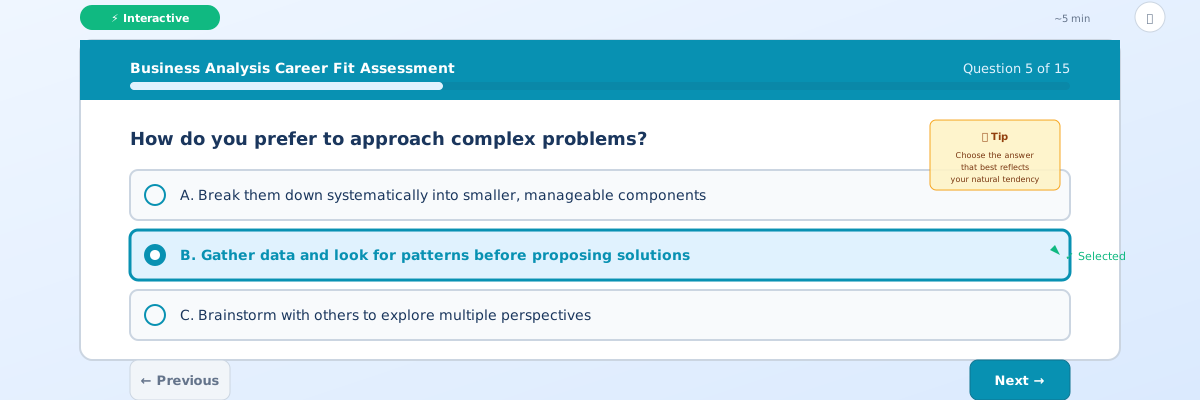
Interactive BA career fit assessment preview showing sample question interface
Understand Why BA Matters

Explore the Business Impact

Learn about the measurable impact business analysis has on project success and organisational outcomes.